DGFT Proposes Revised Rules of Origin for Non-Preferential Imports and Exports
Ansh Mishra
15 Sep 2026
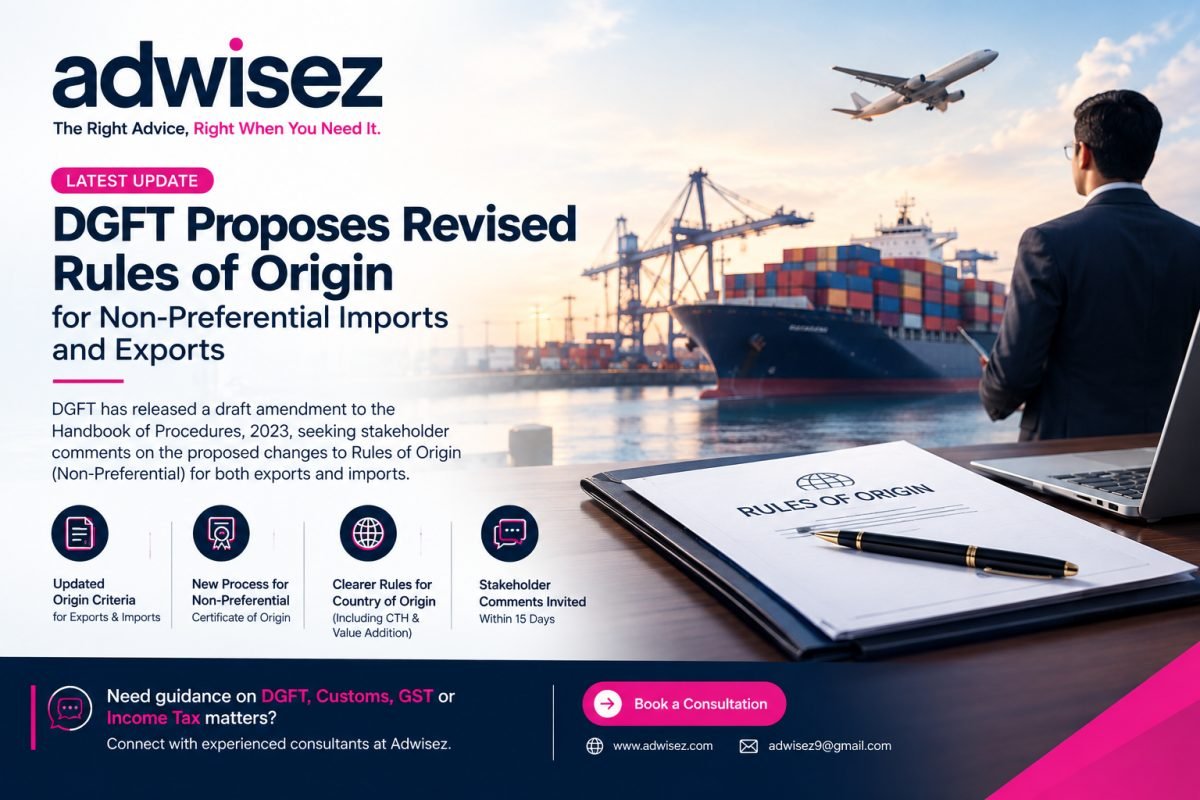
New Delhi, September 15, 2026: The Directorate General of Foreign Trade (DGFT) has proposed a comprehensive amendment to Para 2.93 of the Handbook of Procedures, 2023, relating to Rules of Origin (Non-Preferential).
Through Trade Notice dated 14 September 2026, DGFT has invited comments, suggestions and inputs from importers, exporters, Export Promotion Councils, trade bodies and other stakeholders on the proposed amendment.
What is the proposed change?
The proposed amendment seeks to comprehensively prescribe Non-Preferential Rules of Origin for both exports and imports.
For exports, the draft provides that goods should be manufactured by the exporting entity in accordance with the definition of “Manufacture” under Paragraph 11.31 of the Foreign Trade Policy.
Where imported inputs are used in an export product, the product would qualify as originating in India only where the processing undertaken goes beyond specified simple operations, including basic sorting, washing, painting, cutting, repacking, labelling, simple mixing and simple assembly.
Non-Preferential Certificate of Origin for exports
The draft also sets out the procedure for obtaining Non-Preferential Certificates of Origin (CoO).
Exporters requiring a Non-Preferential CoO would apply online through trade.gov.in to an agency listed under Appendix 2E.
The proposed requirements include:
Uploading the invoice and packing list
A proposed fee of ₹200 per Certificate of Origin
Verification by the issuing agency that the goods satisfy the prescribed Indian-origin criteria
Provision for online correction of an existing eCoO
Provision for agencies to apply for enlistment under Appendix 2E
The draft also proposes self-certification for manufacturer exporters who are Status Holders, subject to fulfilment of the prescribed origin criteria.
Proposed Rules of Origin for imports
One of the significant aspects of the draft relates to determining the country of origin of imported goods.
For goods falling under ITC (HS) Chapters 01 to 14, the country of origin would generally be the country where the goods are wholly obtained or produced, subject to a 1% de-minimis tolerance of the value of the goods.
For other goods, the country of origin would be determined where either:
All non-originating materials undergo a change in tariff heading at the 4-digit HS level; OR
The goods undergo at least 35% value addition.
The proposed value-addition formula is:
Value Addition (%) =
(FOB Value of Exports − Value of Non-Originating Material) ÷ FOB Value of Exports × 100
Importers may use self-declaration
The draft proposes that importers would declare the country of origin based on information available to them and provide a prescribed self-declaration.
Importantly, the proposal states that a separate Certificate of Origin or other origin-related document would generally not be required for clearance, unless specifically mandated under applicable law or a notified country-specific requirement.
Goods would be permitted clearance based on the self-declaration, with subsequent verification possible on a risk-based basis where there are reasonable grounds to doubt the declared origin or where specific country-specific conditions apply.
DGFT invites stakeholder comments
DGFT has invited stakeholders to examine the draft amendment and submit their comments, suggestions and inputs within 15 days from the date of publication of the Trade Notice.
Stakeholders have been asked to send their submissions by email to the address specified in the Trade Notice, with the prescribed subject line.
What this means for importers and exporters
The proposed framework could be particularly relevant for businesses involved in international sourcing, manufacturing, merchanting trade and import of goods, as origin determination can have implications for documentation, customs clearance and compliance.
Importers and exporters should therefore review the proposed rules and assess how the proposed CTH requirement, 35% value-addition test, de-minimis tolerance and self-declaration mechanism could affect their existing transactions and documentation.
Note: The above is based on the draft proposal circulated by DGFT. These provisions should not be treated as final until the proposed amendment is formally notified.
Need guidance on Customs, GST or DGFT matters?
Adwisez connects businesses with experienced consultants, including retired GST, Customs and Income Tax officers with 35+ years of departmental experience, for practical consultation on regulatory and tax matters.
Book a consultation:
www.adwisez.com
Email: adwisez9@gmail.com
The Right Advice, Right When You Need It.