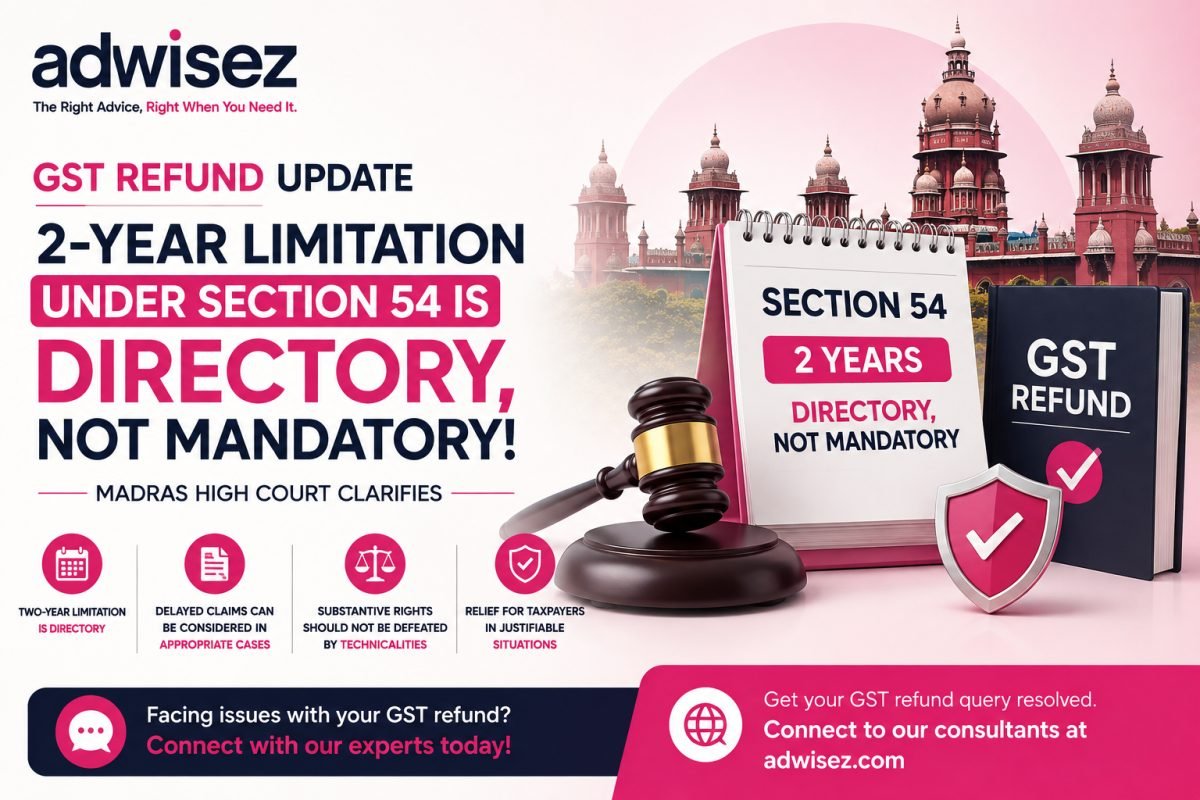
Two-Year Limitation Under Section 54 Is Directory, Not Mandatory: Madras High Court
Ansh Mishra
06 Sep 2026
For businesses, exporters and SEZ suppliers, GST refunds can involve significant amounts of money. However, refund claims are often rejected because of procedural issues, documentation delays or alleged limitation.
An important judgment of the Madras High Court in Lenovo (India) Pvt. Ltd. v. Joint Commissioner of GST (Appeals-1) provides a significant observation on the time limit prescribed under Section 54(1) of the CGST Act.
The key takeaway:
The two-year period prescribed under Section 54(1) for filing a GST refund application is directory in nature and not mandatory.
The Court specifically held that, in appropriate cases, a legitimate refund claim cannot be denied merely because the application was filed beyond two years.
What Does Section 54 Say?
Section 54 of the CGST Act provides the mechanism for claiming GST refunds.
Generally, a person claiming refund is required to make an application before expiry of two years from the relevant date.
However, the Madras High Court examined whether this two-year period should always be treated as an absolute and inflexible bar.
The Court answered no.
Two-Year Limitation Is Directory, Not Mandatory
The Court made an important distinction regarding the language of Section 54(1).
After examining the provision, the Court observed that the language used in Section 54 indicates that the taxpayer “may make application” within two years from the relevant date.
On this basis, the Court held that:
The two-year time limit is directory in nature and not mandatory.
Consequently, in appropriate circumstances, a genuine and legitimate refund claim should not automatically be denied solely because the application was filed beyond the two-year period.
This is particularly important for taxpayers dealing with complicated refund procedures where delays may occur for reasons beyond their control.
Supporting Documents and Refund Applications
Another important issue before the Court was whether supporting documents furnished after the initial refund application could make the entire refund claim time-barred.
The Court referred to Rule 90(2) and Rule 90(3) of the CGST Rules.
Under Rule 90, the proper officer is required to scrutinize the refund application and, where deficiencies are noticed, communicate those deficiencies through the prescribed mechanism.
The Court therefore rejected the argument that merely producing supporting documents subsequently would automatically mean that the refund application itself had been filed beyond limitation.
The Court observed that the two-year period relates to the filing of the refund application, and not necessarily to the date on which every supporting document is ultimately furnished.
Even a Delayed Refund Application May Be Considered in Appropriate Cases
The most significant observation of the judgment is that even a refund application filed beyond two years cannot, in every circumstance, be rejected automatically.
The Court expressly observed that:
“The time limit fixed under section 54(1) is directory in nature and it is not mandatory.”
This means that taxpayers facing a limitation objection in a GST refund matter should carefully examine the facts and circumstances before accepting that the refund claim is legally barred.
The judgment therefore provides an important basis for arguing that substantive refund entitlement should not necessarily be defeated by a rigid application of the two-year period, particularly in appropriate cases.
Delay Caused by Authorities
The Court also considered situations where delay in obtaining necessary documentation was attributable to an authority rather than the taxpayer.
In the case before it, the delay in obtaining the relevant SEZ endorsement was not attributable to the taxpayer. The Court held that the taxpayer could not be penalized for a delay that was beyond its control.
The Court further held that technical defects or inappropriate endorsements should not automatically defeat a genuine refund entitlement where the underlying transaction and tax payment are established.
What This Means for GST Taxpayers
The judgment is particularly relevant to:
Exporters;
SEZ suppliers;
Businesses claiming refund of accumulated ITC;
Businesses claiming refund of IGST on zero-rated supplies;
Taxpayers whose refund applications have been rejected on limitation grounds; and
Taxpayers facing disputes concerning delayed supporting documents.
The key lesson is that limitation under Section 54 should not always be viewed as an absolute mechanical bar.
Where a taxpayer has a genuine substantive refund entitlement, the circumstances surrounding the delay, the conduct of the Department, the availability of documents and the nature of the procedural defect may all become relevant.
What If Your GST Refund Is Rejected Due to the Two-Year Limitation?
If your GST refund has been rejected because the Department says that the application was filed after two years, do not assume that the matter is automatically over.
The applicability of the limitation period should be examined carefully based on:
The relevant date applicable to your transaction;
The date on which the refund application was actually filed;
Any deficiency memo issued by the Department;
The reason for any delay;
Whether the delay was attributable to the taxpayer or an authority;
Whether supporting documents were subsequently submitted;
Whether the substantive refund entitlement is otherwise established; and
The judicial decisions applicable to the facts of the case.
The Lenovo (India) Pvt. Ltd. judgment demonstrates that the two-year period under Section 54(1) is not necessarily an inflexible bar and has been held by the Madras High Court to be directory rather than mandatory.
Get Your GST Refund Query Resolved With Adwisez
GST refund matters can become complicated when limitation, documentation, ITC, exports, shipping bills, SEZ endorsements or refund calculations are involved.
If you have received a GST refund rejection, refund recovery notice, deficiency memo, SCN, or simply want to understand whether you are entitled to a GST refund, it is advisable to get the matter reviewed before taking the next step.
Connect with our consultants at Adwisez.com to get your GST refund query resolved.
Our consultants can help you understand the issue, examine the applicable provisions and guide you on the appropriate course of action.
Need advice on your GST refund?
Connect with an Adwisez consultant today.
Adwisez.com — The Right Advice, Right When You Need It.